
Exercise ISPS Code International Ship and Port Facility Security Code YouTube
For example, if the ship itself, or the port facility it served before, or another ship it interfaced with previously, are considered to be in violation with the provisions of SOLAS chapter XI-2 or part A of the ISPS Code. Maritime security: Implementation of the ISPS Code International Maritime Organization, London, UK
IMO I116E International Ship and Port Facility Security Code (ISPS Code)
The International Ship and Port Facility Security Code (ISPS code), was adopted in December 2002. The code went into effect in July 2004. It established various definitions and procedures to unify the approach to physical security of ports and port facilities. It is accomplished initially through the Port Facility Security Assessment, or PFSA.
The International Ship and Port Facility Security Code An Overview of Key Requirements for

The International Ship and Port Facility Security (ISPS) Code serves some key goals, including, but not limited to: Establish an international skeleton that promotes cooperation among obligated governments, their agencies, local authorities, and the shipping ports. Identification of potential security threats to ships or port facilities used.
TRAINING ISPS (INTERNATIONAL SHIP AND PORT SECURITY) CODE

ISPS compliant port facilities. List of port facilities in Singapore that are compliant with the ISPS Code (pdf). Ship RSOs (Recognised Security Organisations) The MPA has appointed RSOs to approve Ship Security Plan (SSP) and to issue International Ship Security Certificates to Singapore flagged ships on its behalf.
The International Ship and Port Facility Security Code Safety Transport

4.3. - RECOGNISED SECURITY ORGANISATIONS. In its article 4.3 of its Part A, the ISPS Code states the Designated Authority can allow certain Recognised Security Organisations (RSO)5 undertake certain functions related to the security of port installations and services.
International Ship and Port Facility (ISPS) Code IMO
2.2 The term "ship", when used in this Code, includes mobile offshore drilling units and high-speed craft as defined in regulation XI-2/1. 2.3 The term "Contracting Government" in connection with any reference to a port facility, when used in sections 14 to 18, includes a reference to the Designated Authority.
(PDF) International ship and port facility security and port facility security assessment (ISPS

The International Ship and Port Facility Security (ISPS) Code came into force on July 1, 2004 and is applicable to all vessels over 500 grt operating on international trades, as well as the ports that service them. We have played a proactive role in helping the industry to implement the ISPS Code and offers a full range of statutory.
PPT Port Security PowerPoint Presentation, free download ID2953396
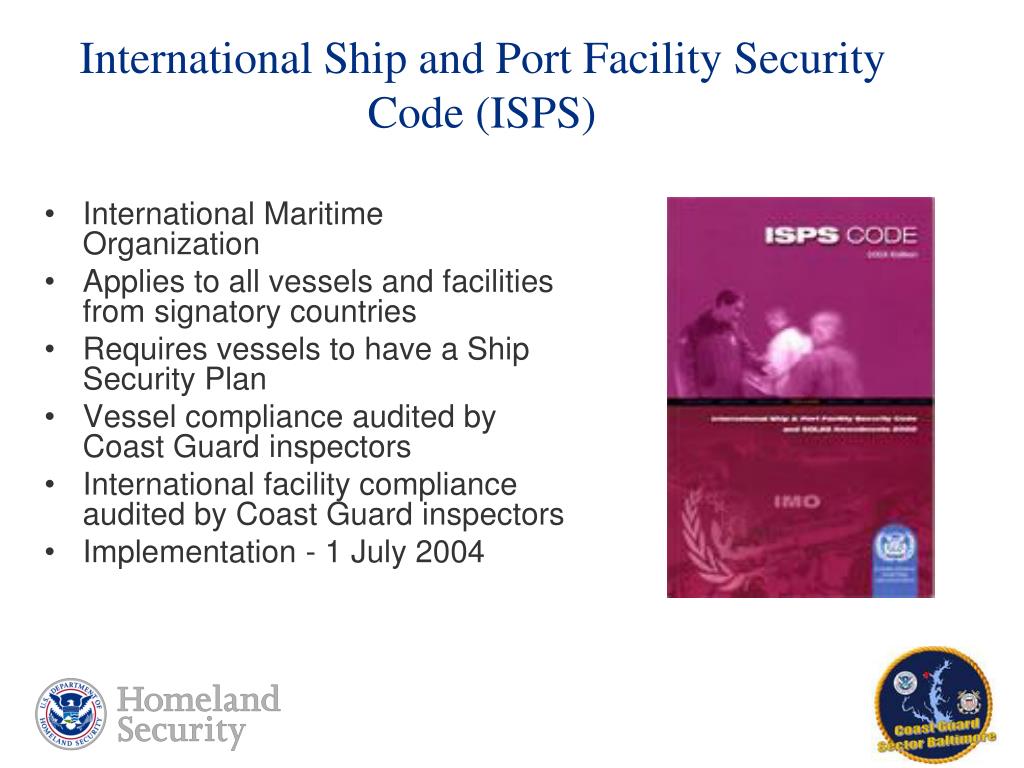
The ISPS code mainly looks after the security aspects of the ship, seafarers, ports and port workers, to ensure preventive measures can be taken if a security threat is determined. The main aim of the International Code for the Security of Ships and of Port Facilities (ISPS) is as follows: To monitor the activity of people and cargo operation.
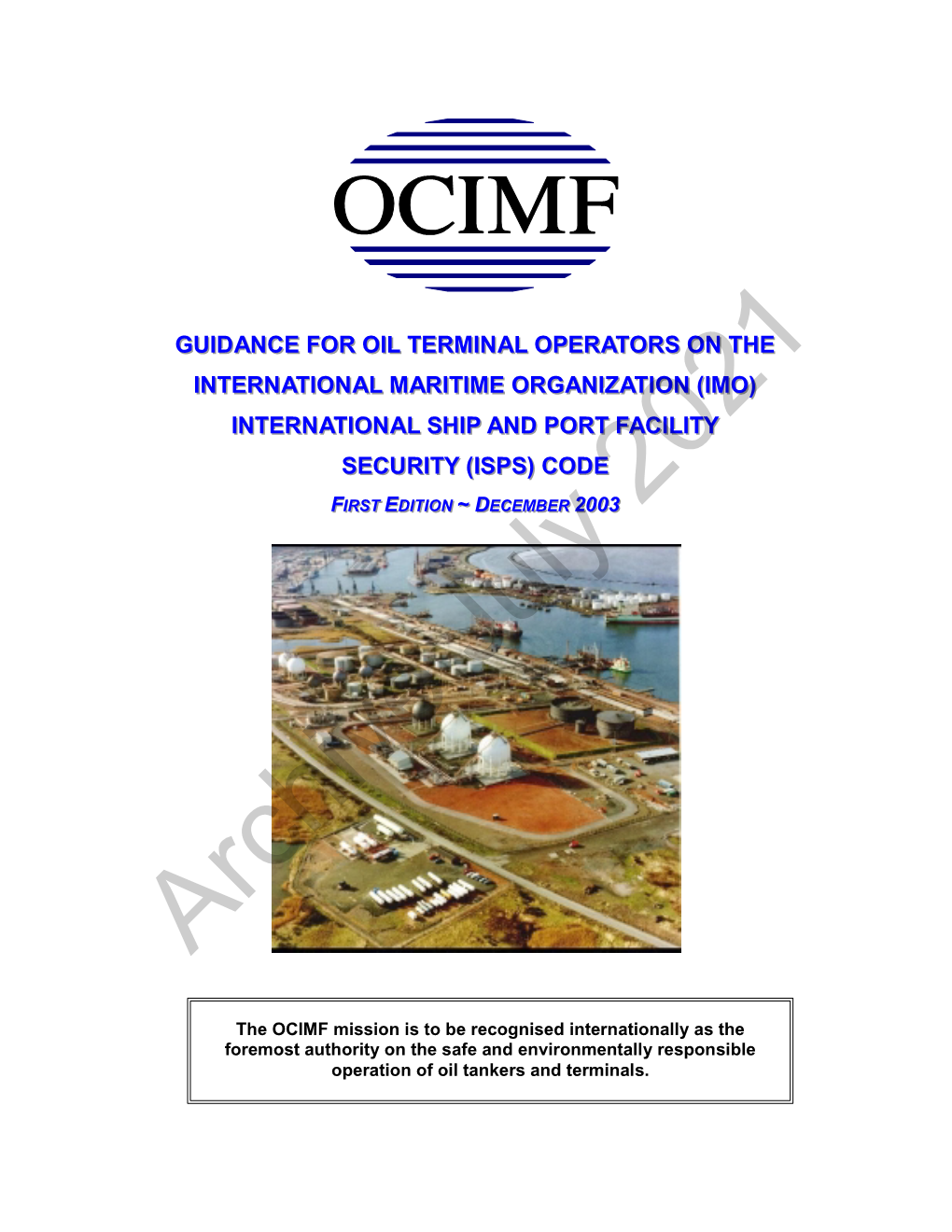
Guidance for Oil Terminal Operators on the International Maritime Organization (IMO
The International Ship and Port Facility Security (ISPS) code is Chapter XI-2 of the International Convention of the Safety of Life at Sea, 1974. Australia is a signatory to this Convention and we fulfil this international obligation through the Maritime Transport and Offshore Facilities Security Act 2003 (MTOFSA) and the accompanying.
(International Ship And Port Facility Code) entered into · PDF fileSOLAS 74 and the ISPS

The International Ship and Port Facility Security (ISPS) Code is a comprehensive set of measures to enhance the security of ships and port facilities, developed in response to the perceived threats to ships and port facilities in the wake of the 9/11 attacks in the United States.
Adoption of the International Ship and Port Facility Security Code to Enhance Maritime Safety

for the Safety of Life at Sea, 1974, the most far-reaching of which enshrined the new International Ship and Port Facility Security (ISPS) Code. The Conference also adopted a series of resolutions designed to add weight to the amendments, encourage the application of the measures to ships and port facilities not covered by the ISPS Code
ISPS The International Ship and Port Facility Security Code Officer of the Watch

The ISPS Code has also helped to facilitate international trade by ensuring that ships and port facilities meet a consistent set of security standards.Overview of the ISPS Code requirements for ships and port facilitiesThe ISPS Code requirements for ships and port facilities are structured around two levels of security: Level 1 and Level 2.
PHỤ PHÍ ISPS International Ship and Port Facility Security Code Nguyen Dang Viet Nam Forwarding

The result of this shifting mindset was The International Ship and Port Facility Security (ISPS) Code. The International Maritime Organization (IMO), a specialized agency of the United Nations, played a pivotal role in developing the ISPS code, which came into force on July 1, 2004.
INTERNATIONAL SHIP AND PORT FACILITY SECURITY CODE [PDF Document]

The International Ship and Port Facility Security Code, 2002. In essence, the Code takes the approach that ensuring the security of ships and port facilities is basically a risk management activity and that to determine what security measures are appropriate, an assessment of the risks must be made in each particular case.
(PDF) PORT SECURITY MEASURES ONE YEAR AFTER THE ENTRY INTO FORCE OF THE INTERNATIONAL SHIP AND

The ISPS Code applies to the following oceangoing ships: mobile offshore drilling units. The ISPS Code has two parts, one mandatory (Part A) and one recommendatory (Part B). The ISPS Code takes the approach that ensuring the security of ships and port facilities is a risk management activity. To determine which security measures are appropriate.
International Ship And Port Facility Security Code The Ultimate FAQ Guide Bansar China

The ISPS Code is the International Ship and Port Facility's security code. It serves as a way to regulate maritime operations to ensure the security of ports, cargo, ships, and the crew on board vessels. The ISPS code is a framework for ports worldwide that allows them to cooperate, interact, and prevent events that may threaten maritime.
.